
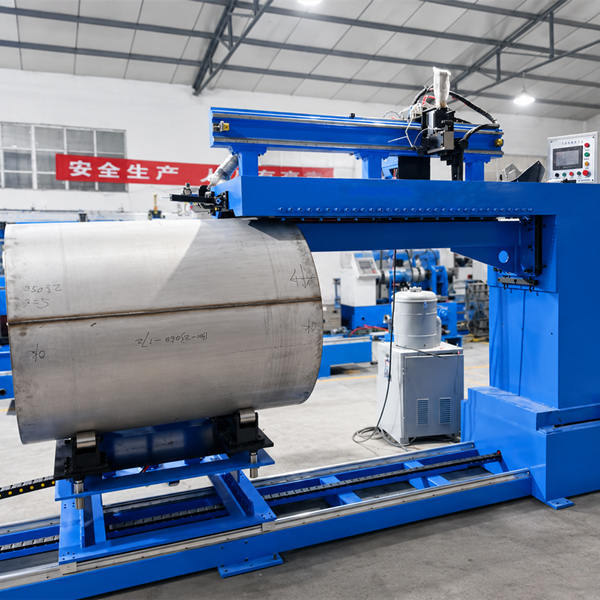
In storage tank manufacturing, welding quality directly affects tank strength, sealing performance, service life, and production safety. For manufacturers of oil tanks, water tanks, chemical tanks, pressure vessels, and industrial storage containers, choosing a suitable automatic welding machine for storage tanks is an important step to improve production efficiency and ensure stable welding quality.
Compared with manual welding, automatic tank welding equipment can provide more consistent weld seams, higher productivity, better appearance, and lower dependence on operator skill. Therefore, it is widely used in modern tank fabrication workshops.
What Is an Automatic Welding Machine for Storage Tanks?
An automatic welding machine for storage tanks is designed to weld different parts of storage tanks automatically or semi-automatically. It can be used for longitudinal seam welding, circumferential seam welding, shell welding, tank bottom welding, tank roof welding, and other related welding processes.
Depending on the tank structure and production requirements, the machine can be configured with different welding methods, such as:
- MIG/MAG welding
- TIG welding
- Submerged arc welding
- Plasma welding
- Automatic circumferential seam welding
- Automatic longitudinal seam welding
The right welding process depends on the tank material, thickness, diameter, production capacity, and welding quality requirements.
Main Applications of Storage Tank Welding Machines
Automatic tank welding machines are widely used for different storage tank products, including:
- Oil storage tanks
- Water storage tanks
- Chemical storage tanks
- Fuel tanks
- LPG storage tanks
- Stainless steel tanks
- Carbon steel tanks
- Pressure vessels
- Industrial containers
- Food and beverage storage tanks
For large-volume tank production, automatic welding equipment can greatly improve production consistency and reduce rework caused by unstable manual welding.
Why Use an Automatic Welding Machine for Storage Tanks?
1. Higher Welding Efficiency
Manual welding usually requires skilled operators and longer working time, especially for long seams and large-diameter tanks. Automatic welding machines can maintain stable welding speed and continuous operation, which helps improve production output.
For manufacturers with regular tank orders, automatic welding equipment can shorten production cycles and improve delivery efficiency.
2. Stable and Consistent Weld Quality
Tank welding requires strong sealing performance and reliable mechanical strength. Automatic welding machines can control welding speed, current, voltage, wire feeding, torch position, and welding angle more accurately.
This helps reduce common welding defects, such as:
- Uneven weld bead
- Lack of fusion
- Porosity
- Undercut
- Excessive spatter
- Weld deformation
- Leakage problems
Consistent welding quality is especially important for storage tanks used in chemical, fuel, gas, or pressure-related applications.
3. Better Weld Appearance
Automatic welding provides a smoother and more uniform weld seam. This is important for stainless steel tanks, food-grade tanks, water tanks, and tanks that require good surface appearance.
A clean weld seam can also reduce grinding and polishing work after welding, helping customers save labor and processing time.
4. Lower Labor Dependence
Skilled welders are becoming increasingly difficult and expensive to recruit in many markets. By using an automatic welding machine for storage tanks, manufacturers can reduce dependence on manual welding skills.
Operators mainly need to set parameters, load workpieces, monitor the process, and perform basic maintenance. This makes production management easier and more standardized.
5. Improved Production Safety
Automatic welding can reduce direct operator exposure to welding arc, heat, smoke, and sparks. With proper safety protection, the working environment becomes safer and more controlled.
For large tank welding projects, automation also reduces the need for workers to operate in difficult or unstable positions.
Key Components of an Automatic Storage Tank Welding Machine
A complete automatic welding system for storage tanks usually includes several important parts:
| Component | Function |
|---|---|
| Welding power source | Provides stable welding current and voltage |
| Welding torch system | Performs the welding operation |
| Wire feeding system | Ensures stable wire feeding during welding |
| Rotation or travel mechanism | Controls tank movement or welding head movement |
| Clamping system | Fixes the tank or tank parts accurately |
| PLC control system | Controls machine operation and welding parameters |
| Touch screen | Allows operators to set and monitor parameters |
| Cooling system | Protects welding torch and key components |
| Safety protection system | Improves operation safety |
A well-designed machine structure ensures stable welding movement, accurate positioning, and reliable long-term operation.
Common Types of Automatic Welding Machines for Storage Tanks
Automatic Circumferential Seam Welding Machine
This machine is mainly used for welding circular seams around the tank body. It is suitable for tank shell welding, end cap welding, nozzle welding, and other circular welding applications.
The workpiece usually rotates while the welding torch remains in a fixed or adjustable position. This design helps achieve continuous and uniform circumferential welding.
Automatic Longitudinal Seam Welding Machine
This equipment is used for welding the straight seam of rolled tank shells. After the steel plate is rolled into a cylinder, the longitudinal seam needs to be welded accurately.
Longitudinal seam welding machines usually require good clamping and alignment systems to ensure straight weld seams and reduce deformation.
Tank Shell Welding System
For large storage tanks, shell welding systems can be designed according to tank diameter, plate thickness, and production process. The system can include welding manipulators, rotators, welding tractors, and automatic control units.
Customized Tank Welding Line
For customers with large production capacity requirements, a customized storage tank welding line can integrate forming, positioning, welding, handling, and testing processes to improve overall production efficiency.
Factors to Consider When Choosing a Storage Tank Welding Machine
Before purchasing an automatic welding machine for storage tanks, customers should confirm several key technical details.
Tank Material
Different materials require different welding methods and parameter settings. Common tank materials include carbon steel, stainless steel, aluminum, and special alloy steel.
Tank Diameter and Length
The tank size determines the machine structure, rotation system, clamping range, and welding travel length.
Plate Thickness
Material thickness affects welding method, welding power, number of welding passes, and heat input control.
Welding Seam Type
Customers should confirm whether they need longitudinal seam welding, circumferential seam welding, tank bottom welding, roof welding, nozzle welding, or multiple welding processes.
Production Capacity
The required daily or monthly output will influence the automation level, machine quantity, and line layout.
Quality Standard
Some projects require strict welding quality standards, inspection reports, pressure testing, or non-destructive testing. In this case, stable automatic welding performance becomes more important.
How Automatic Welding Improves Storage Tank Production
Using automatic welding equipment helps manufacturers build a more stable and efficient production process. It can improve:
- Welding speed
- Seam consistency
- Product quality
- Labor efficiency
- Production standardization
- Delivery capability
- Welding appearance
- Long-term cost control
For storage tank manufacturers, automation is not only about replacing manual labor. More importantly, it helps establish a repeatable and controllable production process.
Customized Solutions for Different Tank Projects
Storage tank projects vary greatly in size, material, structure, and application. Therefore, many customers need customized welding solutions.
A professional supplier can provide machine design based on:
- Tank drawing
- Tank diameter and length
- Material type and thickness
- Welding process requirement
- Factory layout
- Production capacity target
- Automation budget
- Local voltage and safety requirements
Customized automatic welding machines can better match the customer’s actual production needs and improve project success.
Conclusion
An automatic welding machine for storage tanks is an important piece of equipment for modern tank manufacturing. It helps improve welding efficiency, ensure stable weld quality, reduce labor dependence, and support large-scale production.
Whether producing oil tanks, water tanks, chemical tanks, fuel tanks, stainless steel tanks, or industrial storage containers, choosing the right automatic welding solution can help manufacturers improve product quality and long-term competitiveness.
For customers planning to upgrade their tank production process, automatic welding equipment is a practical and valuable investment.